We Had To Be Brave: Escaping the Nazis on the Kindertransport by Deborah Hopkinson


With the same attention to detail and straightforward writing style readers have come to appreciate from her, Deborah Hopkinson looks at how the rescue operation of Jewish children from Nazi occupied Europe, known as the Kindertransport, was able to saved approximately 10,000 young people.


In the first half of this fascinating history, Hopkinson details Hitler's rise to power and ties its impact into the lives of a number of Jewish families. Most people don't realize just how widespread anti-Semitic feelings were in 1930s Germany, but as Hitler became more popular, as his followers increased, many Jews who had believed themselves to be as German as their non-Jewish neighbors began to experience a definite change. For example, Jewish men were arrested and sent to concentration camps for no reason, prohibitions were enacted so that Jews in civil service lost their jobs, Jews couldn't go to the movies or visit a park, Jewish children were no longer allowed to attend German schools. But on November 9, 1938, when Nazis attacked and ransacked Jewish homes, business and synagogues, destroying everything in their path and arresting around 30,000 men, many Jews realized things were not going to get better.


You may wonder why didn't Jews leave long before Kristallnacht? She points out that many Jews believed they could ride out the tempest of anti-Semitism sweeping Germany, that it would soon blow over. But when many realized they had waited too long, and emigration became almost impossible as borders in other countries began to close, a chance for some parents to save their children opened up. Shortly after Kristallnacht, a plan was put in place in Great Britain to get "unaccompanied children up to the age of seventeen" out of Nazi occupied countries without the usual red tape. (pg. 142) The children were chosen from applications that were filled out by parents, often without the child's knowledge. I cannot imagine the level of courage it must have taken for these parents to send their children into the unknown, but I can certainly understand why they were willing to take the chance to get them out of harm's way.


To help the reader fully understand what the Kindertransport was, why parents would be willing to send their children away to live with strangers, most of whom were not even Jewish, Hopkinson uses the personal stories of a number of participants, a cohort group of different ages and backgrounds. Through interviews, written memoirs, and oral histories, as well as an abundance of relevant secondary material, the individual stories unfold, engrossing and increasing the readers understanding of just what these children lived through, before leaving Germany, what it was like traveling to England, and their adjustment to life in a different country, most without knowing even a little English.


Once again, Hopkinson has taken a complicated historical event and made it completely accessible to her young readers. And as if the stories of these Kindertransport children aren't compelling enough, she has included an abundance of secondary resources of readers. There are copious photographs throughout the book, as well as sidebars inviting readers to "Stop, Listen, Remember." Back matter includes information about the people in the book, the;  Survivors, the Rescuers, and the Historians; a Timeline; a Glossary; Look, Listen, Remember: Resources to Explore; a Bibliography; Newspapers, Articles, and Websites for more investigation; and of course, Source Notes.


I've read a lot of books about the Kindertransport, fiction and nonfiction, but this is by far one of the best. As Hopkinson parallels the rise of Adolf Hitler and National Socialism with the lives of Jewish families who ultimately chose to send their children to England, knowing they might never see each other again, she neither romanticizes nor loses her authorial objective eye so that a more complete picture of this little known but no less important historical event emerges.


The Kindertransport lasted only a short amount of time, from December 2, 1938 to May 14, 1940. The stories are harrowing, heartbreaking and although they took place 80 years ago, they couldn't be more timely for today's world, as people are yet again flirting with fascism.


I can't recommend We Had To Be Brave highly enough.


This book is recommended for readers age 9+

This book was an ARC gratefully received from the author.


Book Review: Wolf in Sheep's Clothing by Charlie Adhara

Title: Wolf in Sheep's Clothing
Author: Charlie Adhara
Series: Big Bad Wolf, #4
Publisher: Carina Press
Publication Date: March 2, 2020

Synopsis: Agent Cooper Dayton and his partner, Oliver Park, are going undercover—at a retreat for couples who need counselling. They do say the best cover story is one that’s close to the truth… 

Agent Cooper Dayton is almost relieved to get a phone call from his former boss at the Bureau of Special Investigations. It means a temporary reprieve from tensions created by house hunting with Oliver Park, his partner both in work and in life. Living together in a forever home is exactly what Cooper wants. He’s just not keen on working out the details.

With a former alpha werewolf missing, Cooper and Park are loaned to the BSI to conduct the search at a secluded mountain retreat. The agents will travel to the resort undercover…as a couple in need of counseling.

The resort is picturesque, the grounds are stunning and the staff members are all suspicious as hell.

With a long list of suspects and danger lurking around every cabin, Cooper should be focusing on the case. But he’s always been anxious about the power dynamics in his relationship with Park, and participating in the couples’ activities at the retreat brings it all to the surface. A storm is brewing, though, and Cooper and Park must rush to solve the case before the weather turns. Or before any more guests—or the agents themselves—end up dead.

Review: When I first read the Big Bad Wolf trilogy, I completely fell in love and was heartbroken that it was over. And then Charlie Adhara gifted us with Wolf In Sheep's Clothing. Cooper and Oliver are at it again with their next big mystery. I loved the setting of this book, getting to learn more about AQs, and seeing their relationship further develop. It was a perfect balance between the investigation that kept me on my toes and my favorite duo who kept me laughing and swooning throughout. I am beyond happy the series will be continuning and only a *little* miffed I have to wait till 2021 for the next one...

An ARC was provided by the publisher via NetGalley.

Rating: 5/5 stars

-Kristen ♥

Blog Tour: Tweet Cute by Emma Lord (Excerpt)


Title: Tweet Cute
Author: Emma Lord
Publication Date: January 21, 2020

Synopsis: A fresh, irresistible rom-com from debut author Emma Lord about the chances we take, the paths life can lead us on, and how love can be found in the opposite place you expected. 

Meet Pepper, swim team captain, chronic overachiever, and all-around perfectionist. Her family may be falling apart, but their massive fast-food chain is booming ― mainly thanks to Pepper, who is barely managing to juggle real life while secretly running Big League Burger’s massive Twitter account.

Enter Jack, class clown and constant thorn in Pepper’s side. When he isn’t trying to duck out of his obscenely popular twin’s shadow, he’s busy working in his family’s deli. His relationship with the business that holds his future might be love/hate, but when Big League Burger steals his grandma’s iconic grilled cheese recipe, he’ll do whatever it takes to take them down, one tweet at a time.

All’s fair in love and cheese ― that is, until Pepper and Jack’s spat turns into a viral Twitter war. Little do they know, while they’re publicly duking it out with snarky memes and retweet battles, they’re also falling for each other in real life ― on an anonymous chat app Jack built.

As their relationship deepens and their online shenanigans escalate ― people on the internet are shipping them?? ― their battle gets more and more personal, until even these two rivals can’t ignore they were destined for the most unexpected, awkward, all-the-feels romance that neither of them expected.

About the Author: Emma Lord is a digital media editor and writer living in New York City, where she spends whatever time she isn't writing either running or belting show tunes in community theater. She graduated from the University of Virginia with a major in psychology and a minor in how to tilt your computer screen so nobody will notice you updating your fan fiction from the back row. She was raised on glitter, grilled cheese, and a whole lot of love. Tweet Cute is her debut novel.

Excerpt:

JACK

“Look.” I glance into the classroom, where Ethan is thoroughly distracted by Stephen and no longer keeping an eye on us. “I may have . . . overreacted.”

Pepper shakes her head. “I told you. I get it. It’s your family.”

“Yeah. But it’s also—well, to be honest, this has been kind of good for business.”

Pepper’s brow furrows, that one little crease returning. “What, the tweets?”

“Yeah.” I scratch the back of my neck, sheepish. “Actually, we had a line out the door yesterday. It was kind of intense.”

“That’s . . . that’s good, right?”

The tone of my voice is clearly not matching up with the words I’m saying, but if I’m being honest, I’m still wary of this whole overnight business boom. And if I’m being honest, I’m even more wary of Pepper. If this really is as much of a family business as she claims it is—to the point where she’s helping run the Twitter handle, when even I know enough about corporate Twitter accounts to know entire teams of experienced people get paid to do that—then she might have had more of a hand in this whole recipe theft thing than she’s letting on.

The fact of the matter is, I can’t trust her. To the point of not knowing whether I can even trust her knowing how our business is doing, or just how badly we need it.

“Yeah, um, I guess.” I try to make it sound noncommittal. My acting skills, much like my breakfast-packing skills, leave much to be desired.

“So . . .”

“So.”

Pepper presses her lips into a thin line, a question in her eyes.

“So, I guess—if your mom really wants you to keep tweeting . . .”

“Wait. Yesterday you were pissed. Two minutes ago you were pissed.”

“I am pissed. You stole from us,” I reiterate.

“You stole from an eighty-five-year-old woman.”

“I didn’t—”

“Yeah, yeah, but still. You’re them, and I’m . . . her. It’s like a choose your fighter situation, and we just happen to be the ones up to bat.”

“So you’re saying—you don’t not want me to keep this up?”

“The way I see it, you don’t have to make your mom mad, and we get a few more customers in the door too.”

Pepper takes a breath like she’s going to say something, like she’s going to correct me, but after a moment, she lets it go. Her face can’t quite settle on an expression, toeing the line between dread and relief.

“You’re sure?”

I answer by opening the container she handed me. The smell that immediately wafts out of it should honestly be illegal; it stops kids I’ve never even spoken to in their tracks.

“Are you a witch?” I ask, reaching in and taking a bite of one. It’s like Monster Cake, the Sequel—freaking Christmas in my mouth. I already want more before I’ve even managed to chew. My eyes close as if I’m experiencing an actual drug high—and maybe I am, because I forget myself entirely and say, “This might even be better than our Kitchen Sink Macaroons.”

“Kitchen Sink Macaroons?”

Eyes open again. Yikes. Note to self: dessert is the greatest weapon in Pepper’s arsenal. I swallow my bite so I can answer her.

“It’s kind of well-known, at least in the East Village. It even got in some Hub Seed roundup once. I’d tell you to try some, but you might steal the recipe, so.”

Pepper smiles, then—actually smiles, instead of the little smirk she usually does. It’s not startling, but what it does to me in that moment kind of is.

Before I can examine the unfamiliar lurch in my stomach, the bell rings and knocks the smile right off her face. I follow just behind her, wondering why it suddenly seems too hot in here, like they cranked the air up for December instead of October. I dismiss it by the time I get to my desk—probably just all the Twitter drama and the glory of So Sorry Blondies getting to my head.

“One rule,” she says, as we sit in the last two desks in the back of the room.

I raise my eyebrows at her. “We don’t take any of it personally.” She leans forward on her desk, leveling with me, her bangs falling into her face. “No more getting mad at each other. Cheese and state.”

“What happens on Twitter stays on Twitter,” I say with a nod of agreement. “Okay, then, second rule: no kid gloves.”

Mrs. Fairchild is giving that stern look over the room that never quite successfully quiets anyone down. Pepper frowns, waiting for me to elaborate.

“I mean—no going easy on each other. If we’re going to play at this, we’re both going to give it our A game, okay? No holding back because we’re . . .”

Friends, I almost say. No, I’m going to say. But then—

“I’d appreciate it if even one of you acknowledged the bell with your silence,” Mrs. Fairchild grumbles.

I turn to Pepper, expecting to find her snapping to attention the way she always does when an adult comes within a hundred feet of disciplining her. But her eyes are still intent on me, like she is sizing something up—like she’s looking forward to something I haven’t anticipated yet.

“All right. No taking it personally. And no holding back.”

She holds her hand out for me to shake again, under the desk so Mrs. Fairchild won’t see it. I smile and shake my head, wondering how someone can be so aggressively seventeen and seventy-five at the same time, and then I take it. Her hand is warm and small in mine, but her grip is surprisingly firm, with a pressure that almost feels like she’s still got her fingers wrapped around mine even after we let go.

I turn back to the whiteboard, a ghost of a smirk on my face. “Let the games begin.”

-Kristen ♥

International Holocaust Remembrance Day: Never Shall I Forget by Elie Wiesel


In the preface to his autobiographical narrative about surviving Auschwitz, Night, Elie Wiesel wrote that it is the responsibility of witnesses to history to bear witness, that "[s/he] has no right to deprive future generations of a past that belongs to our collective memory." In Night, "[t]he witness has forced himself to testify. For the youth of today, for the children who will be born tomorrow. He does not want his past to become their future." (pg xv)


In Chapter 3 of Night, Elie describes how he and his father had survived the first selection process by which who lives and who dies is immediately decided upon arriving at Auschwitz Birkenau Concentration Camp, and their subsequently witnessing the burning of the bodies of adults and children that same night. As the Jewish men begin to say the Kaddish, the prayer for the dead, Elie wonders where God is in Auschwitz. Elie breaks out of the narrative form and inserts this poem:


January 27, 2020 marks the 75th anniversary of the liberation of Auschwitz, and sadly there are fewer and fewer people who can bear witness to these atrocities are fewer and fewer every year.


And given some recent events in the world today, where people are again flirting with fascist ideas, remembering the genocide of Jews, Roma, gays, and the disabled committed by men and women eager to blindly support their leader, Adolf Hitler, International Holocaust Remembrance Day reminds us of the importance of not just remembering but also of actively acting against all forms of hate and bias.


Anna at War by Helen Peters


When Daniel's class begins studying WWII, he volunteers that his Granny, Anna Schlesinger, had come to England as a refugee from Germany, but that is all he knows. When he asks her about it, he also discovers that there is an M15 file on her with the Secret Service. Now, Daniel can't wait to hear her story.


And what a story it is, one that really begins on November 9, 1938, Kristallnacht, when the Schlesinger apartment is destroyed by Nazis and Anna's father is arrested and taken to Buchenwald concentration camp. Back home weeks later, a heartbreaking decision is made by her parents to send Anna, 12, to safety in England on the Kinderstransport. No sooner does her journey begin, then she has a sleeping baby boy thrust at her through the train window. Anna cares for the baby, refusing to give the little stowaway up until they arrive in England and she has assurances he will be taken care of properly.


After more traveling, Anna finds herself on an estate farm in Kent with no electricity or indoor plumbing, but with a family that warmly welcomes her into their home - Aunty Rose and Uncle Bert Dean, their young son Frank, 6, and Molly, also 12-years-old and with whom Anna will share a room.


Anna adjusts to English life on a farm, but when Hitler invades Poland, and England and France declare war with Germany, she is crushed as all hope that her parents could also escape to England is completely destroyed.


Meanwhile, a boy at school, Billy Townsend, insists that Anna is a German spy, sending secrets back to help the Nazis invade England, even going so far are to write up a list of reasons to prove it and to turn the other kids in school against her. But when Molly betrays her because of Billy, it is almost more than Anna can take and she begins to avoid Molly as much as possible.


Until an injured man who calls himself Peter Smith and who claims to be a British soldier is found in the hay loft in the barn. He tells them that his mother is very ill and he wants to visit her, even though he doesn't have leave to go, and that he had injured his ankle on his way, so he can't walk. The children are very sympathetic, offering food and water, and even agreeing to mail a letter for him. But after they leave the barn, Anna goes back to get the family cat and hears the soldier speaking German. Realizing he probably is a German spy injured when he parachuted into the area, Molly and Frank refuse to let her report him to the authorities - Frank had repeated some important top secret war-related information to Molly that he had overheard his dad telling his mum. If they report the spy, and he repeats what he may have overheard Frank say, their dad might be tried for treason - punishable by death.


What can they do to get the spy arrested and still keep Mr. Dean safe? They do come up with a plan for that, but will it work?


Some things I really liked about this book:


Anna at War is my favorite kind of WWII story. It's exciting, it has lots of local detail about what WWII was like for those living in the English countryside, and most importantly, it has lots of detail about what life was like in Nazi Germany for Jews like the Schlesinger's. Helen Peters doesn't hold back on her descriptions of the destruction of Jewish homes and businesses on Kristallnacht, the cruel anti-Semitism of people who used to be their friends, and what a few weeks in a concentration camp did to Anna's father. And the decision by the Schlesinger's to send Anna away, not knowing if they will ever see each other again, is presented in all its agonizing difficulty and its emotionally wrenching reality. Yet, it is all handled with a good deal thoughtfulness, considering the age of the target reader.


Anna is depicted as a sensitive girl, who has a strong understanding of right and wrong, and who always tries to act responsibly. She's also pretty courageous, resourceful, stubborn and even defiant when she needs to be - character traits that are made very clear right from the beginning. Her story is compelling and because it is Anna recounting her life to her grandson, it is told in the first person in a voice that is authentic, clear and very powerful.


Peters has also captured the fears of the English that they too could be invaded by Nazi Germany just as so many European countries had been. And fears that spies like Peter Smith were parachuting into England (this did happen, but not all that frequently) to make the invasion easier are also presented in Billy Townsend's insistence that Anna is a spy and his rallying schoolmates, including Molly, into believing such a far-fetched idea is testament to how contagious and persuasive hate can be - even in the schoolyard, even in the face of facts.


Anna at War is a must read for anyone interested in historical fiction set in WWII. I picked it up and couldn't put it down once I started reading. And there is a wonderful denouement that makes Anna journey just so very rewarding.


This book is recommended for readers age 10+

This book was purchased for my personal library


Be sure to check out the other Marvelous Middle Grade Monday offerings, now being carried on by Greg at Always in the Middle. 


Room for One More by Monique Polak


It's 1942 and there is nothing Rosetta Wolfson, 12, likes more than eavesdropping in on a good conversation. So when a man named Mr. Schwartzberg arrives at the Wolfson home in Westmount, a small suburb of Montreal, Canada, Rosetta is right there hiding behind the overhang of the dining room tablecloth. And what she overhears will suddenly change the whole Wolfson family's - Mom, Dad, older sister Annette, 16, and young sister Esther, 6 - dynamic.


The Wolfson sisters are about the get a new brother, 16-year-old Isaac Guttman, a German Jewish refugee who had been part of the Kindertransport, was later interned by the British, and is presently living in a Canadian internment camp.  Coincidentally, while in England, Isaac had been supported for a while by the Wolfson's granny living in London.


It's decided that Isaac will be given Rosetta's room and she will move into Annette's room, an arrangement neither is happy about. Issac's presence, however, doesn't really upset the household very much and it doesn't take long for him and Rosetta to become good friends with each other. Of course, Mr. Wolfson is delighted with Isaac - here is the son he's always wished he had.


So far, the war in Europe has only been an inconvenience to Rosetta's life because of the rationing of things like sugar and butter. Little by little, though, Isaac begins to confide in her about his life in Germany and about his Tante Dora who raised him. But when Isaac gets a letter from Granny saying that his mother wants to reconnect with him, he becomes very upset. Eventually, Isaac tells Rosetta about his mother, who wasn't Jewish, and who, thanks to her perfect Aryan looks, became part of the Nazi regime teaching young girls how to be good wives and mothers, and to hate Jews. She even cruelly turned her back on him in front of her students, treating him as if she didn't know him. More curious than ever, Rosetta goes snooping in Isaac's personal things and discovers the yellow fabric stars that Jews are forced to wear in Germany.


Anti-Semitism isn't something Rosetta has really witnessed before, but then her best friend's older brother goes after Isaac with some vile remarks about being Jewish and letting him know he isn't welcome in Canada. Later, Rosetta learns that are quotas imposed on the number of Jews that can be admitted to McGill University's School of Medicine, the school Isaac is applying to. All of this opens Rosetta's eyes to just what is really happening to the Jews in Europe, and helps her accept Isaac as a brother not just a guest in the Wolfson home.


There are a number of things I liked about this book.


To begin with the title Room for One More could easily have been The Education of Rosetta Wolfson because that's really the main thrust of the story. Rosetta's life had been happy and sheltered, and she had yet to witness anti-Semitism. But it was there all along, it just needed a catalyst to bring it out - like Isaac, with his Jewish background and German accent. And though the story takes place over only 2 months, Rosetta learns life changing lessons about the importance of standing up for what is right. In reading Rosetta's story, I think young readers may also find many parallels between what was happening in 1942 and what is happening in today's world. It certainly resonated for me.


The anti-Semitic events in Germany are presented by Isaac in a very age appropriate way. They are factually correct and clearly painful to Isaac, but they are not graphically described, making this a good book to use for introducing the Holocaust to young readers.


I really liked the Wolfson's family dynamic. The sibling scrapes between Rosetta and Annette reminded me of sharing a room with my own older sister, right down to the line separating their space. And yet, they are able to put aside differences when they need to. I also thought that Rosetta's jealousy over the bond that formed between her father and Isaac was very realistic.


I didn't like that the author sporadically accented the way Isaac spoke. I found his saying things like vas der (was there) or vent der (went there) to be distracting. All that was needed was an occasional mention that Isaac spoke accented English.


I also didn't like so many coincidences. One or two in a novel can feel believable, more than that is troublesome.


All in all, though, Room for One More is a welcome addition to Holocaust literature. It presents a warm, close-knit, happy Jewish family living in Canada, including traditions and inside jokes, and how one person changed their lives forever.  I would highly recommend this poignant, well told novel.


This book is recommended for readers age 9+

This book was purchased for my personal library

Book Review: Graveyard Shift by Jenn Burke

Title: Graveyard Shift
Author: Jenn Burke
Series: Not Dead Yet, #3
Publisher: Carina Press
Publication Date: November 4, 2019

Synopsis: Shifting Into High Fear

Ghost/god Wes Cooper and his not-life partner, vampire Hudson Rojas, have settled into cohabitation in an upscale part of Toronto. So what if their hoity-toity new neighbors haven’t exactly rolled out the welcome mat for the paranormal pair? Their PI business is booming, and when a suspect they’ve been tailing winds up in the morgue, it’s alongside a rash of other shifters in apparent drug-related fatalities.

Now Wes and Hudson must connect the dots between the shifter deaths and an uptick in brutal vampire attacks across the city. Throw in a surprise visit from Hudson’s niece—who may or may not be on the run from European paranormal police (who may or may not exist)—and guardianship of a teen shifter who might be the key to solving the whole mystery (if only she could recover her memory), and Wes and Hudson have never been busier…or happier.

But when a nightmare from Hudson’s past comes back to haunt him, their weird, little found family is pushed to the brink. Mucking this up would mean Hudson and Wes missing their second chance at happily-forever-afterlife…

Review: The Not Dead Yet series has been such a delight to read and Graveyard Shift was a great conclusion. The premise is what first caught my attention and it was executed so well. The overall pacing is phenomenal- Jenn Burke has a way of drawing you and not letting you go! I devoured all three books in four days. The characters are all so amazing and I loved seeing their little family grow throughout the series. Graveyard Shift is definitely the saddest of the bunch, but don't let that deter you! There are still plenty of funny and swoony moments. Wes really comes into his own, Hud opens up more, and the rest of the gang still kicks ass! My fingers are crossed that we will get more books because there's no way Wes & Hudson are going to stay out of trouble!

An ARC was provided by the author.

Rating: 4.5/5 stars

-Kristen ♥

My Survival: A Girl on Schindler's List, A Memoir by Rena Finder with Joshua M. Greene


Like most Americans, I first learned about Oskar Schindler and the 1,200 Jewish lives he was able to save watching Steven Spielberg's movie Schindler's List. And yes, I am sorry to say I have not yet read Thomas Keneally's 1982 book Schindler's Ark (published as Schindler's List in the US). However, you may recall a book published in 2013 called The Boy On the Wooden Box by Leon Leyson, who was a young Jewish boy working for Schindler. Now, we have this book by Rena Finder, who was a still a young girl when she was working for Oskar Schindler.


Rena, who maiden name was Ferber, had lived a pretty happy and comfortable life in Krakow, Poland with her parents Moses and Rosa Ferber. But all that changes in 1939 when the Nazis march into and occupy Poland and World War II begins. First, friends and neighbors begin to turn their backs on their former Jewish friends, and Krakow's Jews are faced with more overt acts of anti-Semitism, even as more and more restrictive laws are imposed by the Nazis. Jews are not longer allowed to go to school, the park, the movies, they are subject to a curfew, and forced to wear a blue and white armband with a Star of David on it signifying that they are Jewish. And soon enough, arrests and deportations of Jews to concentration camps begin.


In 1940, Rena and her parents are issued permits allowing them to remain in Krakow while her father works, but they are forced to leave their lovely apartment and move into the Krakow ghetto - 320 apartments for 3,000 people. Then, on December 31, 1942, Rena's father is arrested despite having a work permit. Sadly, Rena will never see her father again.


Not long after her father's arrest, liquidation of the Krakow ghetto begins and the ghetto's Jews are forced to march to Plaszów Concentration Camp, a march that includes Rena and her mother Rosa. There, they both end up working in Oskar Schindler's factory, a factory that had originally been located near the Krakow ghetto, where he could use cheap Jewish labor. But now that his labor was in Plaszów, they would have to walk 2 1/2 miles each way to get to and from work. Schindler convinces Plaszów's Commandant, Andrew Goeth, to allow him to build a subcamp for the factory's Jewish workers. Amazingly, Goeth agrees to allow this.


Rena's story is told in a very matter of fact way in the first person, but also in a very intimate voice that makes you feel that she is speaking directly to you, the reader. I've given you most of the historical background, but her story is naturally much more personal, recounting what life was life for Europe's Jews under the Nazis, including the fate of some of her family and friends. She also talks in harrowing detail what it was like when she and the other people working for Schindler were sent to Auschwitz-Birkenau in 1944. Luckily, Schindler was able to reclaim them thanks to his list of workers and take them to his new factory in Czechoslovakia. And unlike many real life Holocaust stories, Rena also talks about what her life was like after the war, meeting her husband and moving to America.


My Survival: A Girl on Schindler's List is a very accessible, age appropriate book, perfect for introducing young readers, and especially reluctant readers, to the Holocaust. Rena breaks down the different events on her personal life and how she was impacted by the things done to Jews under the Nazis. The pages of photographs of the Ferber/Finder families at the back of the book makes her story that much more real. Rena's "Closing Thoughts" bring the past into the present with her plea for today's youth to stand up for those people who are being targeted now, reminding us that genocide begins when people begin turn their backs on what is happening to others.


This book is recommended for readers age 10+

This book was purchased for my personal library.


The Year of Goodbyes by Debbie Levy


In January 1938, Juttta Salzberg, an 11-year-old Jewish girl living in Hamburg, Germany with her family, received a new blank Poesiealbum, in which her friends and relatives could write their comments, thoughts, poems, advice, and wishes for Jutta. Along with their handwritten entries, they often included small stickers or hand drawn illustrations. Posiealbums were quite popular at the time. 


In this slim. reissued book, author and Jutta's daughter, Debbie Levy, has poignantly recreated her mother's memories of living in Nazi Germany in the year 1938. Each chapter begins with a page from Jutta's original Poesiealbum, written in German with an added English translation. This is followed by a free verse poem written by Levy. Each verse is written in her mother's voice as a young girl and really captures what was happening and what Jutta thought about what she was witnessing and experiencing within her family, her friends, and Germany itself.


By 1938, Jews in Germany already feeling the force of Nazi power, losing basic rights and freedoms because of changing laws designed to limit Jewish lives more and more. Only wanting to have a somewhat normal childhood, the entries in Jutta's Poesiealbum and the accompanying poems document just how worried by and scared of the Nazis and their futures these children were:


"Yes, I am eleven-and-three-quarters years old.

I used to worry about my grades

and having to eat stuffed cabbage.

But now I wonder,

what will become of us?

What will become of me?


As persecution and roundups being to increase along with Nazi cruelties, the Salzberg family decides that it is time to emigrate to the United States with the help of relatives already living there. But getting Nazi permission to leave the country isn't easy and acquiring the necessary visas from the American consulate is just as difficult. Finally, out of desperation, Jutta's father takes a drastic step in front of his family and the consul. Standing at the window in the consul's office, he tells him:


"that if he must wait longer for visas,

he might as well jump out the window.

'I might as well jump,'

Father tells the man,

'because the Nazis will be

murdering me soon anyway.'"


Finally, with approved visas, the Salzbergs are able to leave Germany, leaving behind family, friends, possessions, and most of their money. Yet, even their train trip to Paris is fraught with tension and fear until they reach the French border. Imagine the mixed emotions they must have felt when they discovered that their arrival in France on November 11, 1938 is the same day as the Kristallnacht pogrom.


The Year of Goodbyes a small book, yet it is very compelling look at what was happening in Nazi Germany through the eyes of a young victim/witness. It is particularly interesting to read what Jutta's friends wrote in the book, thoughts that cover a broad range of fears and hopes. Debbie Levy researched the fate of the family and friends left behind, and you can read about them in her Afterward. Many did not survive the Holocaust, but some did and Jutta was able to reconnect with some of these friends later in her life.


Jutta Salzberg and her daughter Debbie Levy in 2010

Sadly, Jutta passes away on September 4, 2013.


Besides the Afterward, back matter includes a collection of photos of Jutta, her family and friends, a Time Line, a Note on Sources used, and a Selected Bibliography.


You can find a very useful Discussion Guide for The Year of Goodbyes, provided by the publisher, HERE


Here is the book trailer for the original edition of The Year of Goodbyes, still relevant for this edition:


This book is recommended for readers age 10+

This book was purchased for my personal library

Keep Calm and Carry On, Children by Sharon K. Mayhew


It's September 7, 1940 and the sound of the air raid sirens has just begun throughout London. For Joyce Munsey, 11, and her younger sister Gina, 6, that means getting out of their beds and heading out to the backyard and the makeshift, shelter that their dad had dug there, as bombs begin to fall. By September 10th, after witnessing the destruction the bombs had brought into their lives and neighborhood, and after the loss of two neighbors, Joyce's parent decide it time for their daughters to join the next trainload of school children being evacuated to the countryside. On September 11, 1940, Joyce and Gina, unable to even wash up after the previous night's bombing, board a train at Euston Station heading who knows where with a number of other children.


On the journey, the two sisters meet Sam Purdy, 11, and Molly Neal, 12, and after hours and hours of riding, the four of them disembark in a place called Leek. As people look over the evacuees, Sam is chosen quickly by an elderly man who claims to need someone who can help him now that his boys are away fighting. Molly is next, chosen by an elderly lady who likes her humor and cheekiness. And just as Joyce and Gina begin getting worried they would be left behind, a woman and her daughter Phyllis Woods, 10, decide to take in the sisters.


Joyce and Gina's placement works out very nicely, and Phyllis proves to be an instant friend. After a few days, they decide to call on Sam and Molly, to see if they can come out and play for a while. But when they find out he is living with a Mr. Badderly, Phyllis recognizes the name and tells Joyce he isn't a very nice person.


Sure enough, he has Sam working hard in his victory garden and won't let him leave until Joyce, Phyllis, and later Molly help Sam finish his chores. When they finally get away from Mr. Badderly, Sam tells them how badly he is being treated, even forced to sleep in the cellar. But when Sam, Molly, Joyce, and Phyllis discover a hut full of items that are now being rationed, they realize these are things being sold on the black market. I think no one will be surprised to discover who the ringleader of the black marketeers is. But what can a group a kids do about these ruthless crooks?


Keep Calm and Carry On, Children is an interesting story, with lots of everyday details about the early days of the Blitz, and the fear, worry, and trepidation that children must have felt at being sent to strangers in the countryside and away from their family. Many of the evacuees in the book arrived in the countryside in dirty clothes and not have washed, because as the bombing in London increased, the water and gas lines were damaged. That is something I never encountered in a WWII novel about evacuees before. Also, it was so surprising to learn that Joyce and Gina had never used a toothbrush until living with the Woods family. I wonder how common that might have been. The Munsey family was poor in London, and at times, Joyce feels so embarrassment because of it, but was never made to feel bad by Phyllis or her mother.


It took some time to get to the part about the black market and Mr. Badderly's mistreatment of Sam, which sadly really did happen to some of evacuees. I think some of the early details could have been edited out without spoiling the story. Also there were mistakes in the ARC I read, which will hopefully be fixed in the final copy, but it was nothing that would ruin the basic story.


Mayhew's story was inspired by her grandfather's family, when his parents took in two evacuees from London during the war. And one final thing: though she used the slogan in her title, to her credit, Mayhew didn't use it in the story. Keep Calm and Carry On was only to be used in case of invasion, and that never happened.


Keep Calm and Carry On, Children is a novel that should interest young readers interested in history, especially WWII history.


This book is recommended for readers age 9+

This book was an EARC received from NetGalley


Teachers and Librarians! Your Students Can Help Choose Two Prestigious Children's Book Awards


Teachers and Librarians!
Make Selection of Two Bank Street Children's Book Awards Part of Your Elementary Curriculum


Want your students to practice their reasoning, persuasive speaking, and sharpen their visual skills while participating in  selection of Bank Street’s Center for Children’s Literature’s annual best picture and best science, technology, engineering, and math (STEM) books?


First and Second Grade classes may participate 

in the selection of the Irma Simonton Black and James H. Black Award for Excellence in Children’s Literature (Irma Black Award). The award goes to an outstanding picture book for young children – a book in which text and illustrations are inseparable, each enhancing and enlarging on the other to produce a singular whole. The Irma Black Award is unusual in that children are the final judges of the winning book.

Register here.

Learn more here about last year's award and the award curriculum.  Note we will send the 2020 voting link to new registrants in early spring. 


Third and Fourth Grade classes are invited to jury the Cook Prize.  The Cook Prize honors the best STEM book of the year published for children eight to ten. It is the only national children’s choice award honoring a STEM title.

Register here.

Learn more about last year's award and the award curriculum.  The 2020 voting link will be sent to registrants in  early spring. 


Please share this information with your fellow educators and librarians.  Everyone is invited to participate.

A Scarf for Keiko by Ann Malaspina, illustrated by Merrilee Liddiard


A Scarf for Keiko by Ann Malaspina,


illustrated by Merrilee Liddiard


Kar-Ben Publishing, 2019, 32 pages


Ever since President Roosevelt had declared war on Japan on December 7, 1941, the kids in Sam's class have stopped talking to the Japanese American kids at school. Now, Sam's whole class are learning to knit so they can make scarves and socks for the soldiers who are fighting in the war, including Sam's older brother.


But Sam hates knitting and he isn't very good at it, unlike Keiko Saito, whom he's know for years and who sits next to him in school and is a great knitter. But whenever she offers to help him, he refuses. In fact, Sam now refuses to have anything to do with Keiko, even after witnessing her being harassed by a teenager as she rode her bike home from school.


But when Sam's mom sends him to the flower shop for some flowers for Shabbat, he sees that Mr. Saito's grocery has been vandalized and Go Back to Japan is written on the closed flower shop. During the Shabbat meal, Sam's dad tells him and him mom that President Roosevelt has decided going to send people of Japanese ancestry away, fearing they might be spies for Japan.


On Monday, Keiko isn't in school, but Sam sees her after school, knitting in front of her house. At home, Sam's mom tells him the Saito have to pack and leave soon, taking only what they can carry and she has volunteered to care for Mrs. Saito's lovely tea set. On the morning after the Saitos have left, Sam finds Keiko's bike in front of his house with a note for him to use it while she's away and a pair of hand knit socks for his brother Mike.


Thinking that Keiko will be cold where she is in the desert, Sam is determined to learn how to knit something to send her: a lovely red scarf to keep her warm.


A Scarf for Keiko is a great story about tolerance and how easy it is to be swayed by friends into turning on good neighbors and friends because they are being portrayed as being un-American simply for being who they are. It also shows how conflicted Sam is about no longer being friends with Keiko, whose family has been such good neighbors with his family, and the way his brother Mike helped Keiko fix her bike, and then not speaking up when he sees injustice all around him. He conflict is increased when his mother reminds the family that her sisters in Poland are in danger because they are Jewish and that Mike is in danger as a soldier.


The simple illustrations add much to the story and are done in a muted palette of blues, browns, greys, and touches of red that give a retro feeling. Faces are a bit exaggerated so that they reflect the wide spectrum of character's emotions - fear, conflict, worry, sadness, hate, kindness, even happiness.


A Scarf for Keiko is a great picture book for older readers who may be old enough to have witnessed acts of intolerance in today's world and are also conflicted about what is happening.   


Back matter includes an Author's Note that explains why and how people of Japanese ancestry, including Japanese Americans like Keiko and her family, were put in internment camps by President Roosevelt's Executive Order 9066. I need to mention that there is a typo here, stating the date of the Japanese attack on Pearl Harbor as December 6, 1941, when in reality it was December 7, 1941. Other than that typo, this is an excellent book to share with young readers.


Teachers and students can find a useful downloadable Activity Guide for this book HERE


This book is recommended for readers age 7+

This book was borrowed from the NYPL

It Rained Warm Bread: Moishe Moskowitz's Story of Hope, story by Gloria Moskowitz Sweet, poems by Hope Anita Smith, illustrated by Lea Lyon


**Contains Spoilers**

This fictionalize free verse biography chronicles the life of Moishe Moskowitz's life just before and then during the Holocaust. In 1936, Moishe, his mother, father, older brother Saul, and younger sister Bella live in Kielce, Poland. Their home life is warm, loving and religious, though there is some they watch the Nazi threat grow stronger and come closer. On the street, Moishe often has to be on the lookout for Polish boys who "want to pound me like schnitzel" simply because he is Jewish. Moishe's mother often encourages his father to leave for America where they have relatives, and save enough money to send for the family. However, his father keeps refusing to leave, finally agreeing only to discover the opportunity has passed.


Moise is 13-years-old when Nazi Germany invades Poland, and the lives of the Jewish families living there are forever changed. At first, the Moskowitz's hide out in the barn of a Christian friend, but when nothing happens, they decide to return home, only to be rounded up in 1941 to temporarily live in the Kielce ghetto. Somehow, Mosihe's father escapes and joins the resistance. From there, in August 1942, the ghetto is liquidated and Moise's mother and sister are pulled away from the family - never to be seen again.


Moishe and Saul are moved from one concentration camp to another. When his brother comes up with an escape plan, only Moishe survives and, now alone, is sent to Auschwitz, to do hard labor. By 1945, when it is clear the Nazis are losing the war and the Allies are closing in, Moishe finds himself on several death marches. During the first march, he pretends to fall down and manages to convince the guards that he is actually dead. When an unkind farmer finds him, Moishe is put into another group of Jewish prisoners, where he is put into a cattle car. It is here that he finally finds the hope he needs to carry him through, when a group of Czechoslovakian women defy the Nazi guards and toss warm, freshly baked bread into the cars for the people in the cattle cars.


Taken off the train, Moishe begins his second death march, trying the same tactic he used before of falling down as though dead. Left behind, he hides in a haystack. It's here an American soldier who speaks Yiddish finds Moishe.


Yes, Moishe survives the Holocaust and eventually makes his way to Los Angeles, California where he marries and raises a family.  And like most Holocaust survivors, he was reluctant to talk about his experiences under the Nazis. But finally he did, and now his daughter Gloria as shared his stories to poet Hope Anita Smith and together they wrote Moishe's story.


It Rained Warm Bread is told in the first person through a number of short spare, sometimes understated, poems, and divided into seven chapters, each focusing on specific events and time in Moishe's life, Smith has created a record that is as heartbreaking as it is hopeful. Interestingly, the Nazis are metaphorically referred to as predatory wolves throughout, and never really portrayed as human.


The text and the small watercolor wash spot illustrations are all done in shades of brown, and add much to this testimony of a man who bore witness to what was done to Europe's Jews during Hitler's reign.


It Rained Warm Bread is not the book to read if you are looking for a factual account of what happened to Moishe and his family. If that's what you want, or if, after reading Moishe's story you want to find out more, you can find an account of Kielce and the Kielce Ghetto HERE


Instead, be sure to read the Author's Note by Moishe's daughter Gloria for more information about this courageous man who lost everything but found the hope he needed to carry him through those dark days.


This book is recommended for readers age 9+

This book was purchased for my personal library

White Bird, a Wonder Story written and illustrated by R.J. Palacio, inked by Kevin Czap


**May Contain Spoilers**


If you have already read R.J. Palacio's book Wonder, than you might remember 10-year-old Julian, the boy who bullied Auggie and made his life so difficult. Well, every bully has a reason for being like that and so R.J. wrote The Julian Chapter to help readers understand him. And if you've also read The Julian Chapter, you may remember his Grandmére telling him about her experience in WWII, hiding from the Nazis. Well, now White Bird, done in graphic format, expands that story and you won't want to miss it.


Given a school assignment to interview someone he knows for his humanities class, Julian, in a video chat with his Grandmére in France, asks if she would tell him again about the boy named Julien who saved her life during the Nazi occupation of France. As Grandmére begins her story, the novel flashback to that time. Living in Paris with her mother, a math teacher, and father, a renowned surgeon, Sara Blum is a happy, friendly Jewish girl, not very good a math, but very artistic. In school, Sara has been sitting next to a boy named Julien for years, but has never spoken to him. Julien had been stricken with polio and now walks with crutches. Nicknamed Tourteau because of crab-like gait, he is the subject of some pretty cruel treatment, especially by the school bully and Nazi sympathizer, Vincent.


After France falls to the Nazis in 1940, little by little life becomes difficult for French Jews, but Sara and her family live in the free zone (Vichy France - no explanation about this in the text) and they believe they are relatively safe. That is, until the winter 1943, when the Nazis begin roundups. As the Jewish children in Sara's school are rounded up one day and taken away by the Nazis, Sara is able to escape and hide in the unused bell tower. Which is where Julien finds her before the Nazis do (but how did he know she was there?) and sneaks her out through the city sewers, taking her to his family's barn, where she can hide in the hayloft.


Sara remains hiding in the hayloft until the end of the war with the help of Julien and his parents, hiding from nosy neighbors who are believed to support the Nazis, and knowing she will probably never see her parents again.


White Bird is Palacio's debut graphic novel and the graphic format worked for me because I know kids like them and there's a good chance they will read this book. I also like a well-done comic. It doesn't bother me that the panels aren't perfectly lined up and I prefer the inking to be done is soft colors rather that bold garish colors for this targeted age group.  The novel is divided into three parts that take place when Sara is in hiding and after the war, plus a prologue and epilogue in the present day, and each is introduced with a relevant quote by people like George Santayana, Anne Frank, and Muriel Rukeyser. 


So, while I do feel that White Bird is a very worthwhile book when I first read it, a second reading revealed some flaws. As with her other Wonder books, the real agenda of White Bird is to extend the message of kindness, as Julien's mother tells Sara: "In these dark times, it's those small acts of kindness that keep us alive, after all. They remind us of our humanity." But, with this message in mind, it must be very difficult to find a balance of what to reveal and what to not include when writing a Holocaust story. My feeling about White Bird is that it a book full of good intentions, a book about resistance and courage, that carries an important message for today's world, given the rise of nationalism, but doesn't quite find this delicate balance.


This makes it a somewhat flawed novel. Sara lived in a barn's hayloft and yet no Nazis ever demanded to search it, as they did in reality, looking for hidden Jews. And one only gets a hint at the horror of the Holocaust, as when the Nazis discover what happened to the other Jewish school children and kill the marquisard who was trying to save them (what's a marquisard?) Yes, this is dealt with in the back matter, but how many 10-year-olds look at back matter? What drove me really crazy is the Sara was such a passive character. She did nothing to help herself, Julien's family, or the resistance. Maybe I've read too many books where the Jewish protagonist acts that I've come to expect that kind of resistance action. Sara should have been more of a heroic character, but her passivity precludes her from that.


In the end, though, I would highly recommend this book for middle grade readers. What saves it for me is connecting the events of WWII and the Holocaust to the present day policies towards refugees, as Santayana reminds us: those who cannot remember the past are condemned to repeat it.


Back matter does include an Afterword by Ruth Franklin, an Author's Note, a Glossary, a Suggested Reading List, and Organizations and Resources for further research, and a Bibliography.


This book is recommended for readers age 9+

This book was borrowed from the NYPL


Veterans Day 2019: America's Welcome Home by Henry Van Dyke


"The soldier above all others prays for peace, for it is the soldier who must suffer and


bear the deepest wounds and scars of war."


Douglas MacArthur


America At War: Poems Selected by Lee Bennett Hopkins,


illustrated by Stephen Alcorn


Margaret K. McElderry Books, 2008, 96 pages


Today is Veterans Day, a day to honor the men and women who serve in the Armed Forces. This year, I would like to share a poem called "America's Welcome Home" by Henry Van Dyke (1852-1933), an American poet, educator, and Presbyterian minister. I found this poem in an anthology for young readers called America At War, edited by Lee Bennett Hopkins (1938-2019). I chose this poem because Veterans Day, as you may know, was originally called Armistice Day. The poem was written at the end of World War I, with the signing of the armistice on November 11, 1918 and calling for a ceasefire beginning at 11 o'clock in the morning.


In Memoriam


FCP 1955-2001

Soldier for Equality: José de la Luz Sáenz and the Great War written and illustrated by Duncan Tonatiuh


It's not often enough that I get to read and report on books written about Mexicans and/or Mexican Americans in WWI and WWII, but it's not for a lack of heroes, rather it is for a lack of books written about them for kids and teens. So I was really happy to see that Duncan Tonatiuh, one of my favorite Mexican American writers, has written a wonderful new picture book for older readers that is a such an important contribution to the history of Mexican Americans in this country.


Despite being born in the United States, José de la Sáenz and other people of Mexican origin (Tejanos) living in Texas were often harassed and mistreated. They were people who did as much and sometimes more work than the white Texans, but were still treated like second-class citizens. They were prohibited from entering business with signs reading NO MEXICANS ALLOWED, and children were sent to schools that were segregated, small, cramped and ill-equipped. José was proud of his Latinx roots and worked hard, graduating college and becoming a teacher.


Click to enlarge

When the United States entered WWI in 1917, José and other Mexican American men did not hesitate to enlist to defend their country, a country they loved. José was sent to boot camp in Oklahoma, where he and others were still mistreated by their white officers. These were the soldiers who formed the 360th Regiment of the 90the Division of the US Army.


Finally, in June 1918, José and the other soldier left for the war in Europe, arriving in France shortly after. There, José began to study French, relatively easy for him given the similarities it has with Spanish. Because of his quick language skills, José worked in communications in a protected command post instead of fighting in the trenches. In fact, the war ended just before he was finally sent to fight in a attack that José knew would mean the death of thousands of American soldiers.


Click to enlarge

Back in the States, José began to organize the Mexican American soldiers of the 360th to socialize and talk about their experiences. That led to an idea to form organization that would fight for the rights of all Tejanos. But back home in Texas, José noticed nothing had changed. It was time for José and all Mexican American veterans together with other Tejano other civil rights leaders time to organize.  Finally, in 1929, the League of United Latin American Citizens (LULAC) was formed. José remained a member of LULAC, fighting to end racism, prejudice and school segregation, and for equality and justice for all Latinx.


The life and work of José de la Sáenz is certainly inspiring and, might I add, timely. As usual, Tonatiuh has really done some careful research on his subject, using the diaries that José kept over his lifetime to the best advantage in this new work. To give it a feeling of authenticity, simple Spanish phrases like No es justo are included throughout the book, but require no previous knowledge of Spanish, since like French, there is enough Latin in English to understand them. But, because Tonatiuh is a thorough writer, there is a Glossary included in the back matter. Also included in the back matter are references to the quotes and paraphrases from José's diaries that are used in the text, an important Author's Note, a Timeline of WWI and José's involvement, as well as a Timeline of the League of United Latin American Citizens, and a Select Bibliography.


Tonatiuh's flat, geometic hand drawn illustrations are done in a palette of dark earth-tones, then digitally collaged, and are done in the same style as his other books. This style is based on the Pre-Columbian 15th century art of the Mixtecs, an indigenous group from Southern Mexico, and Tonatiuh has been using it ever since to foster a sense of pride in Mexican culture for his readers.


This is a wonderful book for anyone interested in WWI and/or Latinx history and I highly recommend it. It would be an especially nice book to share with students for Veterans Day which is coming up on November 11, 2019.


You might want to pair this with other Mexican wartime heroes found in The School the Aztec Eagles Built: A Tribute to Mexico's World War II Air Fighters by Dorinda Makanaõnalani


You can find out more about Duncan Tonatiuh and his art on his website HERE


You can read an article with more information on José de la Sáenz and the 360th Regiment in France HERE


This book is recommended for readers age 7+

This book was purchased for my personal library

Infinite Hope: A Black Artists' Journey from World War II to Peace, an Autobiography by Ashley Bryan


Infinite Hope: A Black Artists' Journey from World War II to Peace,


an Autobiography by Ashley Bryan


Caitlyn Dlouhy Books, 2019, 112 pages


I've always been such an admirer of Ashley Bryan's work for young readers, so I was really interested when I heard he had written a book about his World War II experiences. Born and raised in Bronx,  New York, Ashley was a 19-year-old art student at the prestigious art college Cooper Union in Manhattan when, in 1943, he received his draft notice. The United States had already been at war since December 7, 1941, when Japan attacked the U.S. naval base at Pearl Harbor in Hawaii so he had been expecting to be drafted.


Though he had experienced prejudice growing up, the Army was the first time Ashley had ever experienced overt segregation and it began right at the start of his military career. He was quickly assigned to the 502nd Port Battalion, Company C and made up of only Black soldiers, where he became a winch operator. Stationed in Boston, his job was to load and unload supplies of all kinds on or off ships. In Boston, Ashley makes friends with some of the local kids, drawing with them and sharing cokes.


After a few months, the 502nd was sent to Glasgow, Scotland, where Ashley continued working as a stevedore loading and unloading supply ships. And the Scottish people, Ashley notes, welcomed the Black soldiers warmly and treated them like equals despite the Army's continued attempts to enforce their segregation policy by working the stevedores such long hours, making them too tired to venture out and socialize with the welcoming Scots. However, Ashley's battalion commander, Colonel James Pierce had a real appreciation for the arts, and gave Ashley permission able to attend the Glasgow School of Art. Not only that, but Colonel Pierce also created the 502nd Port Battalion band after noticing the many gifted musicians among the stevedores.


Ashley's time in Glasgow came to an end too quickly for him, and on June 2, 1944, the 502nd Port Battalion found themselves heading for the coast of Normandy and the invasion they had spent so much time preparing for.


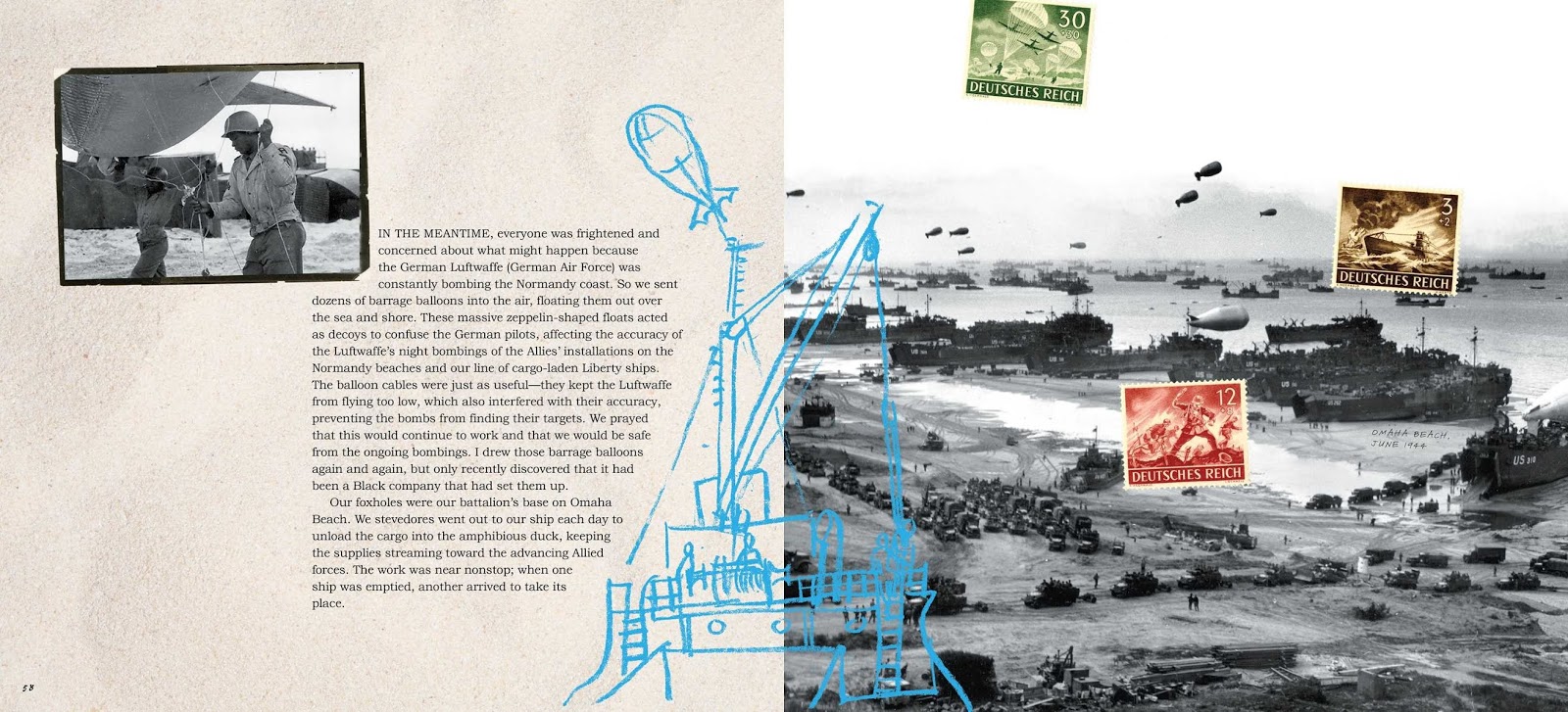
Ashley's ship was anchored off the Normandy coast, at Omaha Beach where, beside loading and unloading ships, his battalion was to invade and clear the beach of land mines, a dangerous job give to the Black soldiers, many of whom lost their lives when mines exploded. Then they were ordered to dig foxholes where they would sleep and could take cover from enemy fire, and also to send up huge barrage balloons to make it difficult for the German Luftwaffe to attack for above.


All the while, Ashley carried paper and drawing materials with him, recording all that he witnessed. And yet, all of those drawings were carefully put away for most of Ashley's live, because, like many soldiers, he simply did not want to speak about or be reminded of his wartime experiences: "In a sense, I hid those drawings away just as I hid my experiences from those three years." (pg. 97) And it has taken for Ashley almost a lifetime to be able to finally confront his wartime experiences.


Using spare prose, and told in the first person as though he is speaking directly to you, Ashley allows his words, his illustrations and his letters to tell his story, together with photographs of the time that he's overlaid with sketches. And he manages to give readers an intimate view of what WWII was like for him and other black soldiers, to capture all the horrors of war, and the racism and injustice he and his fellow blacks soldiers were subjected to, always given the lowest, the meanest, often the most dangerous jobs to do, but also he records acts of camaraderie, kindnesses and genuine friendship.


I've gone over this book again and again, captivated by all of the boldly painted illustrations made from his sketches. It is easy to see how art helped him through those terrible years: "What gave me faith and direction was my art. In my knapsack, in my gas mask, I kept paper, pens, and pencils." (pg. 60) These sketches and illustrations are now a treasure trove of information to add to the history of African Americans in this country, and the history of WWII in general.


You can also hear Ashley Bryan speak about his WWII exhibit and his experience as a stevedore during the Battle of Normandy HERE


Pair this book with Courage Has No Color: the True Story of the Triple Nickles, America's First Black Paratroopers by Tanya Lee Stone, where you will also find some of Ashley Bryan's wartime sketches.


Infinite Hope is an autobiography not to be missed.


This book is recommended for readers age 10+

This book was purchased for my personal library