Infinite Hope: A Black Artists' Journey from World War II to Peace, an Autobiography by Ashley Bryan


Infinite Hope: A Black Artists' Journey from World War II to Peace,


an Autobiography by Ashley Bryan


Caitlyn Dlouhy Books, 2019, 112 pages


I've always been such an admirer of Ashley Bryan's work for young readers, so I was really interested when I heard he had written a book about his World War II experiences. Born and raised in Bronx,  New York, Ashley was a 19-year-old art student at the prestigious art college Cooper Union in Manhattan when, in 1943, he received his draft notice. The United States had already been at war since December 7, 1941, when Japan attacked the U.S. naval base at Pearl Harbor in Hawaii so he had been expecting to be drafted.


Though he had experienced prejudice growing up, the Army was the first time Ashley had ever experienced overt segregation and it began right at the start of his military career. He was quickly assigned to the 502nd Port Battalion, Company C and made up of only Black soldiers, where he became a winch operator. Stationed in Boston, his job was to load and unload supplies of all kinds on or off ships. In Boston, Ashley makes friends with some of the local kids, drawing with them and sharing cokes.


After a few months, the 502nd was sent to Glasgow, Scotland, where Ashley continued working as a stevedore loading and unloading supply ships. And the Scottish people, Ashley notes, welcomed the Black soldiers warmly and treated them like equals despite the Army's continued attempts to enforce their segregation policy by working the stevedores such long hours, making them too tired to venture out and socialize with the welcoming Scots. However, Ashley's battalion commander, Colonel James Pierce had a real appreciation for the arts, and gave Ashley permission able to attend the Glasgow School of Art. Not only that, but Colonel Pierce also created the 502nd Port Battalion band after noticing the many gifted musicians among the stevedores.


Ashley's time in Glasgow came to an end too quickly for him, and on June 2, 1944, the 502nd Port Battalion found themselves heading for the coast of Normandy and the invasion they had spent so much time preparing for.


Ashley's ship was anchored off the Normandy coast, at Omaha Beach where, beside loading and unloading ships, his battalion was to invade and clear the beach of land mines, a dangerous job give to the Black soldiers, many of whom lost their lives when mines exploded. Then they were ordered to dig foxholes where they would sleep and could take cover from enemy fire, and also to send up huge barrage balloons to make it difficult for the German Luftwaffe to attack for above.
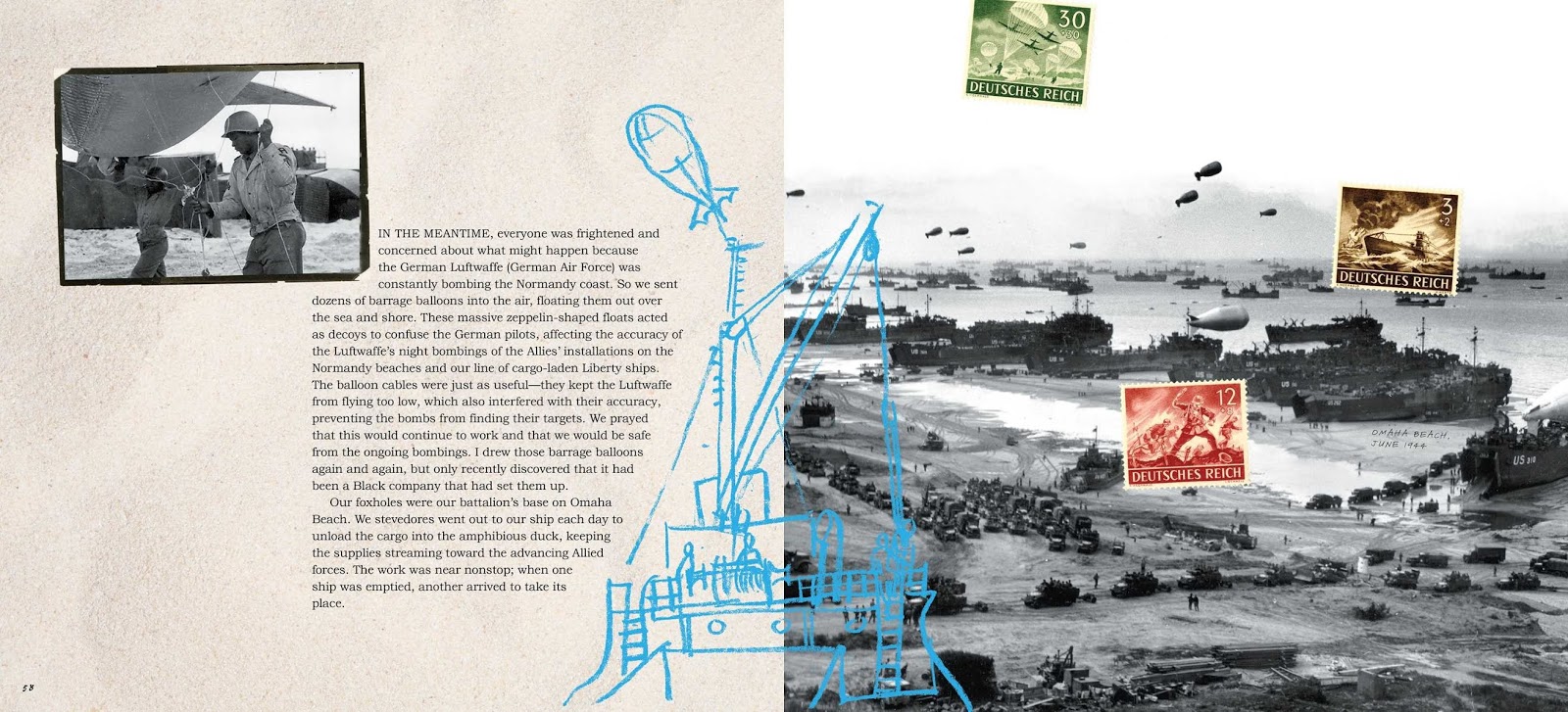


All the while, Ashley carried paper and drawing materials with him, recording all that he witnessed. And yet, all of those drawings were carefully put away for most of Ashley's live, because, like many soldiers, he simply did not want to speak about or be reminded of his wartime experiences: "In a sense, I hid those drawings away just as I hid my experiences from those three years." (pg. 97) And it has taken for Ashley almost a lifetime to be able to finally confront his wartime experiences.


Using spare prose, and told in the first person as though he is speaking directly to you, Ashley allows his words, his illustrations and his letters to tell his story, together with photographs of the time that he's overlaid with sketches. And he manages to give readers an intimate view of what WWII was like for him and other black soldiers, to capture all the horrors of war, and the racism and injustice he and his fellow blacks soldiers were subjected to, always given the lowest, the meanest, often the most dangerous jobs to do, but also he records acts of camaraderie, kindnesses and genuine friendship.


I've gone over this book again and again, captivated by all of the boldly painted illustrations made from his sketches. It is easy to see how art helped him through those terrible years: "What gave me faith and direction was my art. In my knapsack, in my gas mask, I kept paper, pens, and pencils." (pg. 60) These sketches and illustrations are now a treasure trove of information to add to the history of African Americans in this country, and the history of WWII in general.


You can also hear Ashley Bryan speak about his WWII exhibit and his experience as a stevedore during the Battle of Normandy HERE


Pair this book with Courage Has No Color: the True Story of the Triple Nickles, America's First Black Paratroopers by Tanya Lee Stone, where you will also find some of Ashley Bryan's wartime sketches.


Infinite Hope is an autobiography not to be missed.


This book is recommended for readers age 10+

This book was purchased for my personal library

Allies by Alan Gratz


Beginning just before dawn on June 6th, 1944 and ending close to midnight on the same day, Gratz weaves together six unrelated perspectives that bring the D-Day landings to life in all its chaotic, grim reality.


Private Dee Carpenter is a 16-year-old who lied about his age to get into the Army, but since they needed soldiers, the Army looked the other way. Dee and Sid Jacobstein became friends right from the start in boot camp. But Dee wonders what Sid, a Jewish American, would think if he found out Dee's truth.


Samira Zidane, 11, and  her mother Kenza are French Algerians working in the French Resistance. Six hours before the invasion begins, mother and daughter are on their way to deliver an important message about the invasion to the Resistance when Kenza is arrested and taken into custody by the Nazis. Samira delivers the message, and is determined to find and help her mother escape her captors.


James McKay, 19 and Sam Tremblay, a Cree Indian, are in the 1st Canadian Parachute Battalion and about to jump into the midst of the invasion. James decided to join the army after his home town of Winnipeg staged a mock Nazi invasion. Now, though, he is wondering what he is doing parachuting into France on D-Day. His pal Sam, despite being promoted to Lance Corporal, still faces insults and microaggressions as a First Person from the other men, who are white.


Bill Richards, 19, from Liverpool, England is a Private in the Royal Dragoons, and a tank driver just like his dad was in WWI. Bill was named after and is obsessed with William the Conquerer and determined to get to get to Bayeux, France to see the famous Bayeux Tapestry. But he was also obsessed with getting to Amiens, France where his father had carved "Jack Richards was here 1918" on a stone, and Bill was determined to add his name underneath.


Corporal Henry Allen, 20, is an African American medic in the 320th Barrage Balloon Battalion. And even though the United States military is segregated, Henry is on Omaha Beach, risking his life, dodging bullets and racist comments to save the lives of the mostly white soldiers shot and injured as the D-Day landings happen.


Monique Marchand, a 13-year-old French girl with an interest in medicine, was swimming with friends on Normandy Beach the day before the D-Day and ended up in the swimming hut on the beach during the invasion because of a forgotten bathing suit. When she notices an injured soldier, she leaves the hut to help him and that's when she meets Dorothy Powell, an American journalist for Collier's Magazine, there to write about the invasion.


There's not much more to say about this incredible book without giving too much away. Some of the people will live to see the end of the day, others won't, but all contribute to giving a broad view of this important day and what it was like. And Gratz doesn't hold back, so just know this is not a book for the faint at heart.


One of the things I really liked was how Gratz divided the day into the names of different operations. He explains in the back matter that some of the operation names are real, and some he made up to fit the story. Either way, it gives the reader a real sense of time passing and what might have happened. But be sure to read the Back Matter where you will find so much more information.


Gratz also includes a map to give readers a sense of place, since some of the landing units ended up in the wrong beach in all the chaos.


Click to enlarge

WOW! Allies is a great work of historical fiction by a great storyteller. I found myself spellbound from the first word of Allies to the last, but then again, I had the same experience with Gratz's other books, namely Prisoner 1065, Refugee, and Grenade.


This book is recommended for readers age 9+

Thank you, Scholastic Press, for providing me with a copy of this book.

White Eagles by Elizabeth Wein


Twins Kristina and Leopold Tomiak have always been fiercely competitive with each other and also share a love of flying. Naturally, when it looks like Germany is getting ready to go to war, they both sign up for the Polish Air Force Reserve. But when only Kristina is accepted into the White Eagles, Leo is totally perplexed.


Not long after becoming an Eagle, Kristina is assigned to fly an important visitor from the Vistula Aeroclub outside Warsaw to a meeting in Lvov, in southern Poland, to relay important information. But just as the plane carrying the visitor lands, it is clear that it has been attacked by machine gun fire. It turns out the Luftwaffe has been scouting over Poland and shot at their plane. The visitor is killed but the plane's pilot is still alive and knows what the information is.


Now, it's Kristina's job to get the information to Lvov, which she does, safely arriving at Birky airstrip just outside the city limits on August 31, 1939, and where her brother is already waiting for her. The next morning, Kristina wakes up to sirens and an announcement that the German Army has begun its invasion of Poland. The next day, the battle for the airstrip at Birky begins, and Kristian is taken prisoner by a German soldier.


In the sky, she sees two fighter planes caught in a dogfight, without firing at each other, but fighting with only their planes and Kristina realizes the pilot in the Polish plane is her brother. Leo finally comes out the victor, after causing the German plane to crash. But his victory is short lived. Held by the arms by two German soldiers, a German officer pulls his gun and shots Leo between the eyes, as Kristina watches stunned and horrified.


As the other prisoners around her go berserk over the shooting, Kristina, devastated over losing her twin, manages to take advantage of the chaos and to get to her plane. Without a helmet or goggles, she takes off, flying away from her brother's murder and not landing until she finally finds a narrow, clear field in an apple orchard. But no sooner has she landed, than she realizes she isn't alone. A gun is pointed at her head and she was told to put her hands up and get out of the plane. Thinking it is a Nazi soldier, imagine her surprise when it turns out to be an 11-year-old boy named Julian Srebro with a story to tell and a desperate need to get out of Poland. What follows is an exciting, perilous journey for both Kristina and Julian, marked by grief, biting cold, hunger, kindness, cruelty and a few pieces of life-saving chocolate Hanukkah Gelt


White Eagles is a short book written in three parts and inspired by real life aviation hero Anna Leska, liaison pilot for the Polish Air Force and flying missions for them when the Nazis invaded Poland on September 1, 1939 (do read the Author's Note at the back of the book for more information). It is a well researched novel that contains a lot of information about what life for the Polish people was like right after Hitler's army invaded their country. Around that reality, Wein has woven a historical fiction novella that will hold readers captive until the end. But, let's face it, Wein is a master historical fiction storyteller and she knows just how to create characters and settings that make you question whether it is fact or fiction you are reading.


I bought White Eagles at the Book Depository in part because it is written by Elizabeth Wein and in part because it is published by Barrington Stoke, a children's book publisher in Edinburgh, Scotland. And what makes this book special, besides the great story, is that Barrington Stoke publishes books that are adapted for reluctant and dyslexic readers. And since I'm a dyslexic reader, I know first hand how really important the design of these book is. I first discovered them when I read D-Day Dog by Tom Palmer and now I'm sold on them. And no, I get nothing for talking about these books, and there are lots of them by great authors, not from Book Depository or from Barrington Stoke. It's just my experience.


This book is recommended for readers age 9+


At the Mountain's Base by Traci Sorell, illustrated by Weshoyot Alvitre


At the Mountain's Base by Traci Sorell,


illustrated by Weshoyot Alvitre


Kokila, 2019, 32 pages

"At the mountain's base

grows a hickory tree.

Beneath this sits a cabin."


And in this cabin lives a Cherokee military family. Watched by her grandchild, a worried grandmother weaves together red, gold, green, and black threads while sitting by an old wood burning stove where there is something warm and nourishing cooking in a well-worn pot. The women in the family sit with her and together they sing and worry, too. Over their shoulder, is a picture of a woman in military dress.


The family sings a song of protection for the woman in the photo, a pilot flying in WWII. The perspective changes to show the woman pilot involved in that battle, protecting and defending her country, and offering up her own prayerful plea for peace. Hovering over her is the spirit of her families prayers for her safe return.


Again the perspective changes back to the cabin at the mountain 's base, under the hickory tree. There, too, the spirit of her families prayers and and the family awaiting the pilot's return.


Using soft, very spare, lyrical language, Sorell and Alvitre manage to convey so much to the reader about this family and the love they have for each other, and especially their family member in such a dangerous situation. Within the circularity of the story, the old and new are seamlessly woven together, and reflected in the different generations of women in the cabin. The threads of the grandmother's traditional Cherokee finger weaving are wonderfully juxtaposed with the newness of Native American women flying planes for the military. 


One of the things I loved about the artwork for At the Mountain's Base is the way the grandmother's threads wrap around the illustrations, binding the family together even when they are apart. The palette of earth tone red, greens, browns, yellows have a generous amount of white space that really helps call attention to the specific details on each page.


The Author's Note pays homage to the Native women who have served in battles and conflicts over time, and to those active service-members in today's military.  Her main focus is on Ola Mildred Rexroat, a Oglala Lakota pilot who was one of 1,074 Native women who served in the WASPs (Women Airforce Service Pilots) in WWII.


 At the Mountain's Base a celebration of Cherokee women and of the unsung women who make history. It isn't often enough that I get to write about Native Americans in WWII, let alone a woman, so I was very happy to discover this beautiful picture book and I think you will enjoy reading and exploring it, as well.


This book is recommended for readers age 6+

This book was purchased for my personal library

True Brit: Beatrice - 1940 (Book 1 in the Far and Away trilogy) by Rosemary Zibart


It's September 1940, the Blitz is already in full swing, and the last thing 12-year-old Beatrice Sims wants is to be sent away to Santa Fe, New Mexico for safety while her family, parents and older brother, stay behind in London. An upper middle class girl, Beatrice travels in first-class comfort, first by train, then by ship across the Atlantic Ocean, and finally, by train across the United States from New York to New Mexico.


Before she leaves London, her father suggests Beatrice think of her trip as an adventure and herself as an explorer, giving her a red leather notebook to fill with all the different and interesting things she will see and do and experience while away. Her mother, however, is convinced that the war would be over by Christmas and Beatrice would come home.


Arriving in Lamy, New Mexico, Beatrice finds herself alone in a small train station, with only a sleeping cowboy on a bench. Eventually, Clem Pope arrives with two chickens and a beat up truck named Maude. Clem is the local practical nurse, the only one around now that the world was at war and everyone expected the US would be in it soon enough. Her house is comfortable but nothing like Beatrice is accustomed to.


The first day of school, Beatrice meets Esteban, son of Delores, who helps Clem in the house, and Arabella, who introduces her to her new surroundings as only a 12-year-old would know them. But soon enough, Beatrice discovers that Esteban and his friends think she is faceta, a spoiled little Princess. Beatrice is upset by this nickname, especially because she really likes Esteban. Hurt that the kids think about her that way, she also discovers and can't understand that many Americans don't want to get involved in the war in Europe or help England in its fight against the Nazis.


But when Beatrice decides the change her reputation, she discovers it isn't as easy as she would have liked. After a few unfortunate incidents, things aren't looking good. It will take one big life-or-death incident to really turn things around for Beatrice, not just how others see her, but, more importantly, how she begins to see herself.


True Brit is the first book in Rosemary Zibart's trilogy about the different experiences of young people from war-torn countries during WWII, now living on the American home front. It is an engaging story, one I found I couldn't put down. And I thought Zibart really did a great job in depicting Beatrice's culture shock as she begins to adjust to her new surroundings. I could understand how Beatrice felt since I was once a New York City girl who found myself living in a desert area for four years.


Zibart also looks at the class differences between Beatrice and Arabella and most of the kids they are in school with, kids who are native, biracial, and poor by comparison. Yet, neither one is presented as better than the other, but accepted for who they are as people. In that regard, readers see how the stereotype ideas Beatrice arrives in New Mexico with about the land, culture and people are dispelled as she gets to know and understand her new surroundings better. Beatrice does records her adventures in the red notebook her father gave and these entries give the reader more insight and information than even Beatrice's first-person narration does.


Of course, True Brit are some humorous moments - her first hot dog with mustard and relish, her first milkshake, and American slang - is all A-okay. But it is the eye-opening experiences that she has that really make a difference. Beatrice arrived in New Mexico, very much a fish out of water, a self-involved, pampered and privileged girl who expected to be taken care of by servants much the way her mother is. And yet, despite her flaws, I found Beatrice to be a likable character who really grows and comes appreciate her new, temporary (?) home.


Astute readers who are also fans of The Lion, The Witch, and the Wardrobe by C.S. Lewis will like the scene on the train station where Beatrice sees and envies a girl named Lucy and her siblings getting on another train to stay with great-uncle in the country. Interestingly, Beatrice recalls that scene later in the book as she wishes she could be a comfortable as Clem is in her new setting, and envying those four children again.


True Brit is an interesting, informative book that gives readers another detailed look at the life of a young girl in WWII who finds herself in a totally different land and culture than what she is accustomed to.


You can download an Activity and Discussion Guide courtesy of the publisher, Kinkajou Press, HERE


This book is recommended for readers age 9+

This book was sent to me by the publisher, Kinkajou Press

Sunday Funnies #31: Batman with Robin in Swastika Over the White House


Have a Happy Batman Day!


I know it's Saturday, but I thought I'd do a Sunday Funnies post anyway since today is Batman Day, celebrating 80 years of the Caped Crusader and my Kiddo's favorite Superhero. This Batman story is called "Swastika Over the White House." It's from Batman Vol. 1, No. 14 and was published in January 1943. It's one of the few stories that actually relate to the war, although Batman and Robin lots of other things to help the war effort.


Fred Hopper a/k/a Fritz Hoffner may have fooled the other cameramen, but now he has orders to get rid of Batman. As luck would have it, Batman and Robin were coming by the Gotham City Newsreel offices that very day to help with the nation's war effort. Suddenly, a car appears and shots are fired at the dynamic duo.


The young Nazi spy may not have gotten rid of Carson, but he does manage to swap out their camera footage of the shipyard to give to his superiors, along with footage of bomber plants, including gasoline storage tanks. Meanwhile, Bruce Wayne and Dick Grayson, in reality Batman and Robin, have suspicions about the cameramen, so that night, out comes pair in the Batmobile, to check on the industrial suburbs of Gotham City.